
automated print on demand side hustle: Automated Print-on-Demand Side
Learn how to launch a profitable automated print-on-demand side hustle with AI. This 2026 guide covers the best tools, niche selection, and marketing strategies to build a passive income stream from scratch.
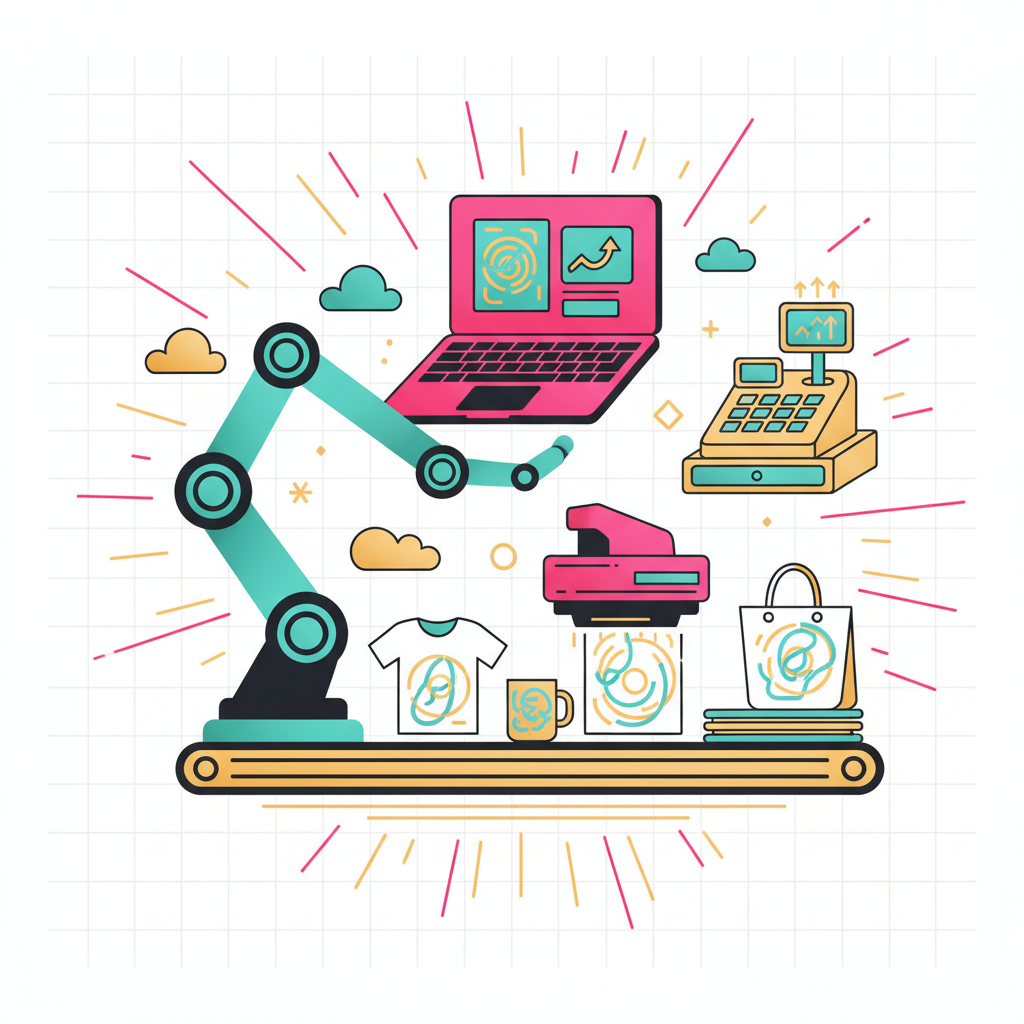
TL;DR: An automated print on demand side hustle leverages AI for rapid design creation and copywriting, then uses third-party services to produce and ship custom products directly to customers, often via platforms like Etsy. This setup minimizes upfront costs and operational involvement, allowing you to quickly test product ideas, scale effectively, and earn income by focusing on creative strategy and market trends.
What Exactly Is an Automated Print on Demand Side Hustle?
If you’ve explored online income streams, the appeal of "passive income" is undeniable. However, the reality for most online ventures often demands constant upkeep, content creation, or customer service. This is precisely where a modern, AI-powered automated print on demand side hustle redefines the equation. It's a business model that merges creative vision with robust technology to forge a revenue stream that generates income for you, even during your downtime, by systemizing over 90% of the operational workflow.
At its essence, print-on-demand (POD) operates on a straightforward principle:
- You craft a unique design.
- You apply this design to a product template (e.g., a t-shirt, coffee mug, or wall art).
- You list this virtual product in an online storefront.
- Upon a customer's purchase, a third-party print provider handles the printing of your design onto the product, packaging, and direct shipping to the customer.
This means you never manage inventory, nor do you pay for a product before a sale is secured. Your primary role shifts to that of a creative director—the system takes care of the rest.
Why Does An Automated Print on Demand Side Hustle Offer a Unique Advantage?
The barrier to entry for e-commerce has never been lower, which presents both opportunities and challenges. While it democratizes starting a business, it also leads to crowded markets. An automated POD strategy provides a distinct advantage by enabling you to:
Test concepts with zero financial risk: You can generate and list dozens of unique designs for highly specific niche audiences and observe market reception without investing a single dollar in inventory. This allows rapid iteration and data-driven decisions within days, not weeks. Many successful sellers launch 50-100 designs in their first month to identify best-sellers, investing only $10-$20 in listing fees. Scale operations efficiently with AI: AI can assist you in generating 100 design variations or product descriptions in the time it would typically take to manually create just one. This dramatically increases your capacity for market saturation and testing, potentially reducing design creation time by 80-90%. For example, creating 10 unique t-shirt designs and their descriptions might take a human 20 hours, but with AI tools, this can be reduced to 2-4 hours. * Prioritize high-leverage activities: Rather than getting entangled in order fulfillment, inventory management, and shipping logistics, you can concentrate your energy on creativity, strategic marketing, and identifying your next profitable niche. This means dedicating 80% of your time to strategy and design, and only 20% to operations and customer service.
This model isn't about achieving overnight wealth. It's about constructing a sustainable, scalable, and genuinely enjoyable business that can add a significant income stream to your financial portfolio. For additional strategies on leveraging technology for income, explore our insights on [AI Side Hustles for Beginners](/blog/ai-side-hustles-for-beginners-2026).
How Do You Find Your Niche for an Automated Print on Demand Side Hustle?
The most prevalent error new POD sellers make is creating generic products for undefined audiences. A t-shirt simply stating "I Love Coffee" faces competition from literally hundreds of thousands of similar items. Conversely, a mug inscribed with "May Your Patients Be Patient and Your Coffee Be Strong," specifically for a nursing student, is highly targeted, resonates deeply, and is considerably more likely to result in a sale. Niche selection is paramount for any successful automated print on demand side hustle.
Your objective is to identify a "niche"—a focused segment of the market characterized by passionate individuals with specific interests.
Here’s a structured approach to pinpointing yours:
Begin with Your Core Interests: What are your hobbies? Which online or offline communities do you participate in? What inside jokes are common within your professional or social circles? The most robust niches often stem from areas you already possess inherent understanding and enthusiasm for. Are you an avid knitter, a Dungeons & Dragons Game Master, or a devoted indoor plant parent? Start exploring these avenues. Explore Niche Intersections: Combine two or more seemingly disparate ideas to create a unique sub-niche. Instead of merely "dogs," consider "retro-futurism for corgi owners." Rather than "reading," think "dark academia aesthetic for fantasy novel fans." This blending can significantly reduce competition, often by 80% or more compared to broad categories. Utilize Research Tools Effectively: Etsy Search Bar: Begin typing a broad concept (e.g., "gardening gift") and observe the autosuggestions. This directly reveals what potential customers are actively searching for on the platform. Pay attention to longer-tail keywords that appear. Reddit: Scour subreddits relevant to a potential niche (e.g., r/urbangardening, r/boardgames). Pay close attention to recurring memes, common frustrations, and specific terminology. This offers invaluable insights for design concepts and evocative phrasing. Look for communities with 10,000+ members but not so large they're overwhelming (e.g., 500,000+). eRank or Marmalead (from $5.99/month): These are specialized Etsy SEO tools that provide granular data on keyword search volume, competitive intensity, and adjacent niche opportunities. They can help validate your niche choice before significant investment. For example, eRank might show "corgi gifts" has 5,000 searches/month with medium competition, while "retro corgi owner gifts" has 500 searches/month with low competition—indicating a better starting point with less competition.
Effective niches often revolve around specific professions (accountant, veterinarian, software engineer), hobbies (bouldering, tabletop gaming, quilting), or distinct aesthetics (goblincore, cottagecore, minimalist design). Continue refining until you have a detailed profile of your ideal customer, understanding their humor, aspirations, and buying habits.
What's the Essential Tech Stack for An Automated Print on Demand Side Hustle?
To effectively implement this business model, you require a streamlined set of tools to bridge the gap between your creative ideas and the marketplace. Here’s a recommended starter stack optimized for beginners:
1. AI Design Generation:
Midjourney ($10/month for Basic Plan): This tool excels at producing high-quality, artistic AI imagery. It's ideal for generating intricate illustrations, seamless patterns, and visually striking assets. While it operates via Discord, requiring a minimal learning curve, its output quality for artistic concepts is exceptional. Expect to spend 2-4 hours initially learning effective prompting, but then generate designs in minutes. DALL-E 3 (via ChatGPT Plus, $20/month): Its primary strength lies in its ability to interpret natural language prompts and generate images that accurately incorporate text. If your design requires precise wording, such as "World's Okayest Dad," DALL-E 3 is generally more reliable than Midjourney for textual accuracy (achieving 90%+ accuracy versus Midjourney's 50-60% for consistent, readable text).
2. Print-on-Demand Provider:
This crucial partner physically produces your custom-designed products. You connect their service directly to your online storefront. The leading choices include Printify, Printful, and Gelato. For beginners, Printify is frequently recommended due to its expansive product catalog and competitive pricing structure.
| Feature | Printify | Printful | Gelato | | :-------------------- | :----------------------------------------------------------------------------------------------------- | :------------------------------------------------------------------------------------------------------ | :-------------------------------------------------------------------------------------------------------- | | Pricing Model | Free plan available. Premium ($29/mo or $24.99/mo billed annually) offers average 15% product discounts. Estimated savings: $50-100/mo for active sellers. | Free to use. Prices are all-inclusive (product + printing). Generally higher per-item cost than Printify, averaging 5-10% higher for comparable products. | Free to use. Gelato+ ($14.99/mo) offers shipping discounts. Local production can reduce international shipping costs by 10-30% and delivery times by 3-7 days. | | Product Catalog | Extensive (950+ items), with multiple suppliers for each type of product, offering choice in quality/price flexibility. | Curated catalog focused on consistent, high-quality blanks and finished goods. Approximately 300-400 items. | Strong global network with local printing in 33 countries, emphasizing fast localized fulfillment. Approximately 300+ items. | | Best For | Beginners seeking maximum product variety and competitive base pricing to test diverse niches rapidly. | Sellers prioritizing a premium brand image and consistent product quality across orders, willing to pay slightly more for reliability. | International sellers needing rapid, localized shipping and lower cross-border fulfillment costs, particularly for global reach. |
3. E-commerce Platform:
Etsy: This is the optimal starting point. It boasts a massive, pre-existing audience actively searching for unique, handmade, and customized products. While per-sale fees are higher (listing $.20, transaction 6.5%, payment processing 3% + $0.25), you avoid the significant undertaking of building an audience from scratch. Listings are typically live within 15-20 minutes. It serves as an excellent training ground for various [side hustles](/categories/side-hustles). Shopify ($29/month for Basic Plan): This represents the long-term growth objective. With Shopify, you retain full ownership and complete branding control. However, you are solely responsible for driving 100% of your own traffic. The recommended approach is to begin on Etsy, and once you achieve consistent sales (e.g., 20+ sales/month for 3 consecutive months) and identify proven products, either expand to or transition your operations to a dedicated Shopify store. Shopify store setup takes 8-12 hours for a basic theme.
Step-by-Step Launch Guide for Your Automated Print on Demand Side Hustle
Ready to transform your ideas into live products? Here’s the streamlined process from concept to published listing for your automated print on demand side hustle:
Step 1: Niche Down & Select Your Initial Product. Let’s assume you've identified the niche "witty gifts for book lovers" and decided to launch with a tote bag as your first item.
Step 2: Generate Designs with AI. Access Midjourney or DALL-E 3. Your prompt needs to be highly specific. Avoid generic requests like "book design."
Example Effective Prompt: Tote bag design, minimalist line art of a stack of books with a steaming cup of coffee next to it, text below that says "Just One More Chapter", clean vector style, white background, no shading, 300 DPI for print
Generate multiple options (aim for 5-10 initial concepts). Refine them iteratively. Ensure your final image file is high-resolution (at least 300 DPI at the intended print size, typically 4500x5400 pixels for a t-shirt or tote). Utilize AI image upscalers like Upscale.media if your initial output isn't sufficient quality for printing; this can take 1-2 minutes per image.
Step 3: Set Up Accounts & Establish Connections. Create your Printify account and establish your Etsy shop (if you haven't already). Within the Printify dashboard, navigate to "My Stores" and follow the clear, step-by-step instructions to link your Etsy shop. This typically involves a few clicks and authorizations, taking less than 10 minutes.
Step 4: Create Your Product in Printify. Browse the Printify catalog, select a tote bag model that aligns with your vision (e.g., a "Gildan 183 tote bag" for durability, costing approximately $9.00), and click "Start Designing." Upload your AI-generated design. Precisely position it on the product, select available color options, and save your work. Critically, Printify will then automatically generate realistic mockups—photorealistic images of your design on the physical product, essential for compelling listings. This entire step usually takes 5-10 minutes per product.
Step 5: Publish the Listing to Etsy. From within Printify, you can set your retail price (aim for a 40-50% profit margin after Printify costs and Etsy fees, so a tote costing $9.00 might sell for $22.00-$25.00), input a preliminary title and description, and then click "Publish." The product, complete with all generated mockups and initial details, will be seamlessly pushed to your Etsy shop as a draft listing within 1-2 minutes.
* Step 6: Optimize the Etsy Listing. Go to your Etsy shop's drafts section. Now, leverage AI again for optimization. Use a tool like ChatGPT (even the free version is effective) with a prompt such as: Write a compelling Etsy title (under 140 chars) and a detailed, benefit-driven description (300-500 words) for a tote bag for book lovers. The design is a minimalist drawing of books and coffee and says "Just One More Chapter". Include 13 hyper-relevant SEO tags (short phrases, comma separated: e.g., "book lover gift, reading tote, literary accessory").
Paste the AI-optimized title and description into your listing. Add all 13 suggested tags. Double-check your pricing. Hit "Publish." This optimization process takes about 10-15 minutes per listing.
Your product is now live and discoverable. When a customer purchases it, the order is automatically routed to Printify, typically within 15 minutes. They handle the printing, packaging, and direct shipment to the customer within 2-7 business days. You remain entirely hands-off after the initial setup. This forms the bedrock of the automated system, making it an exceptionally powerful and efficient [side hustle](/categories/side-hustles).
Overcoming Common Hurdles in Your Automated Print on Demand Side Hustle
While the concept of an automated print on demand side hustle is appealing, new sellers often face specific challenges. Knowing these ahead of time can save you significant frustration and time, usually preventing common mistakes that lead to an 80% churn rate in the first 6 months for new POD sellers.
Design Quality and Uniqueness: The biggest differentiator in a crowded market is genuinely unique and high-quality designs. Avoid using simple, generic phrases or clip art. Focus on creating designs that resonate deeply with your chosen niche. Invest time in learning advanced AI prompting techniques or consider using graphic design software like Canva Pro ($12.99/month) or Affinity Designer ($54.99 one-time purchase) to refine AI outputs or create entirely original graphics. Marketing and Visibility: Simply listing products isn't enough. Etsy is a marketplace, but standing out requires effort. Etsy SEO: Continuously refine your titles, descriptions, and tags based on keyword research (as discussed with eRank/Marmalead). Aim for at least 13 relevant, long-tail tags per listing. Update these quarterly to reflect search trends. Pinterest: Create visually appealing pins for each product, linking directly to your Etsy listing. Pinterest is a visual search engine and can drive significant organic traffic (often 10-20% of initial sales). Dedicate 15-30 minutes per week to this. Mockups: Use high-quality, diverse mockups (Printify generates good ones, but consider purchasing bundles from Etsy sellers for $5-$15 for even more variety) to showcase your products in different contexts and on various models. Customers respond better to lifestyle photos than plain product shots. Customer Service: Even with automation, you're still responsible for customer interactions. Respond to inquiries within 24 hours. While fulfillment is automated, customers will contact you with questions about orders, shipping, or returns. Outline clear policies on your Etsy shop under the "Shop Policies" section (takes about 30 minutes to set up). Having pre-written responses for common questions can save you hours. Pricing Strategy: Don't just pick a price randomly. Calculate your costs accurately (product base cost + printing + shipping from Printify, plus all Etsy fees). Aim for a minimum of a 30-45% profit margin. Undercutting your prices won't guarantee sales and will only lead to burnout. Start slightly higher and use Etsy's sales features periodically. For example, a $9 product with $4 shipping and $2.50 in Etsy fees needs to sell for $26 to hit a 40% profit margin. Tool Integration & Troubleshooting: While the tech stack is largely seamless, occasionally integrations might glitch or a product might not push correctly. Familiarize yourself with the support documentation of Printify and Etsy. Most common issues are resolved by disconnecting and reconnecting the store, or clearing platform cache. Allow 1-2 hours for learning these platforms initially.
By proactively addressing these areas, your journey with an automated print on demand side hustle will be far smoother and significantly more profitable.
FAQs for Your Automated Print on Demand Side Hustle
Q1: How much money do I need to start an automated print on demand side hustle? You can start with as little as $10-$20/month. Your primary costs will be AI tool subscriptions (e.g., Midjourney at $10/month) and Etsy listing fees ($.20 per listing for four months). You only pay for the physical product and shipping when a customer makes a purchase, so inventory costs are literally zero, making it highly accessible.
Q2: How long does it take to see sales with an automated print on demand side hustle? It varies widely. Some sellers see sales within a few days of launching, others take weeks or months. Consistency in uploading new, niche-specific designs (aim for 2-3 new listings per week) and continuous optimization of your listings significantly increases your chances of earlier sales. Building a catalog of 50-100 unique listings typically increases sales velocity.
Q3: Can I really make "passive income" with this model? While highly automated, it's never 100% passive. You'll still need to create new designs, optimize listings, respond to customer inquiries, and perform some marketing. However, the operational side (production, shipping) is entirely outsourced, freeing up significant time compared to traditional e-commerce, making it semi-passive.
Q4: What if a customer wants a refund or has an issue with their order? You are responsible for customer service. For quality issues or misprints initiated by the print provider, Printify/Printful generally offer reprints or refunds (check their specific policies). For sizing issues or buyer's remorse, your shop policies dictate returns. Clearly communicate these policies upfront in your Etsy shop policies (e.g., "no returns on custom items unless flawed") to manage customer expectations effectively.
Q5: Is print on demand saturated? Is there still room for new sellers? While the print on demand market has many sellers, it is far from saturated for highly niched, high-quality designs. Generic items face immense competition, but a unique product targeting a specific sub-niche (e.g., "vintage gaming mom t-shirts" or "hydroponic gardening minimalist art") can still thrive. Success hinges on finding underserved audiences and consistently delivering creative, appealing products that stand out.
_Last reviewed: 2026-06-19_
Frequently asked questions
Written by
Profit Playground
Creators, makers, and operators shipping AI-powered digital products in public.